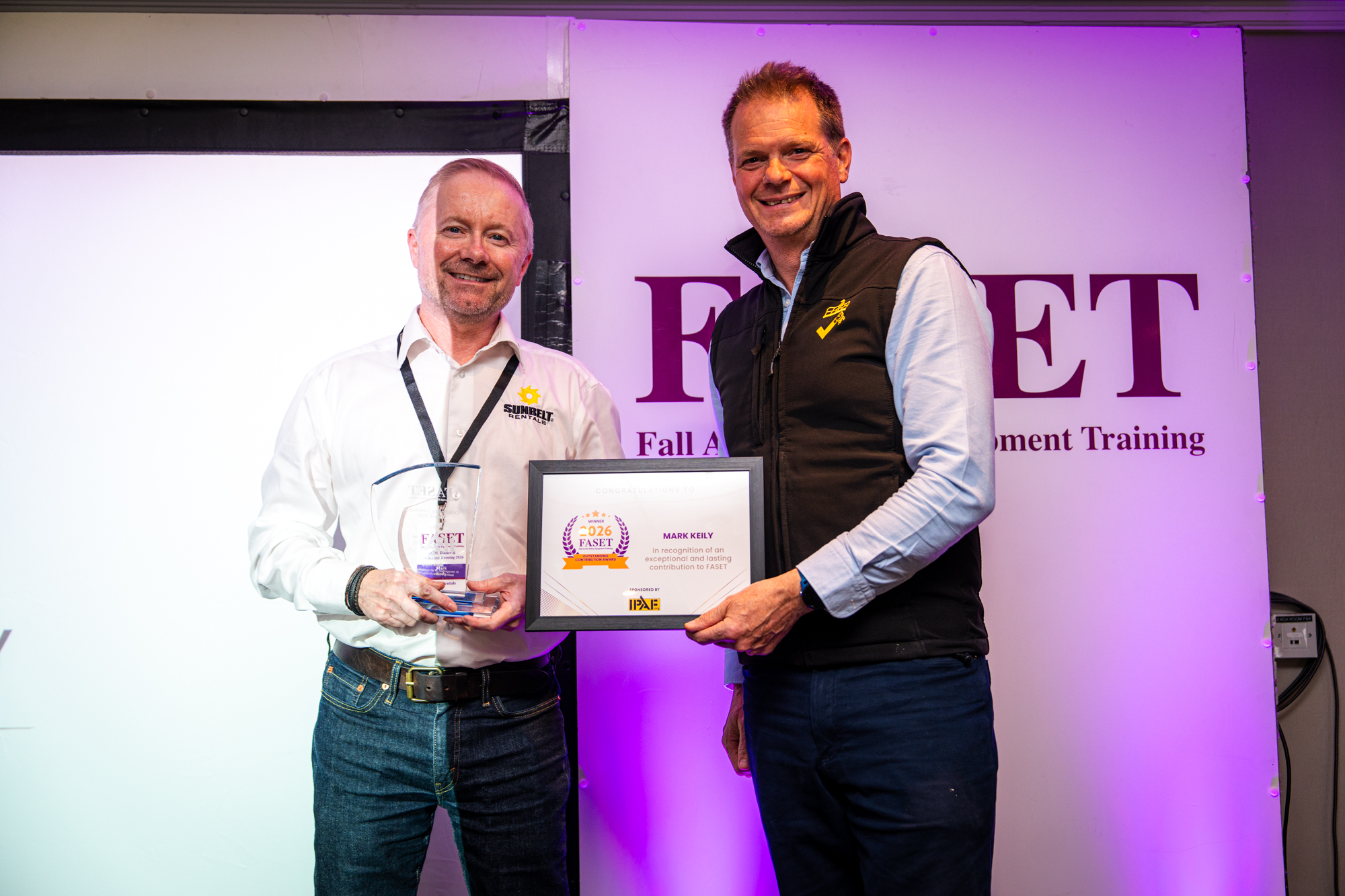
When a steel erector fell six metres on a construction site in 1996, Mark Keily saw how easily a life could be lost. Thirty years later, his contribution to improving safety has been recognised with FASET’s Outstanding Contribution Award.
The man was wearing a harness. He had nowhere to attach it.
For Mark Keily, that detail has stayed with him for three decades. The steel erector survived the fall, eventually recovered and returned to work. But the incident left Mark, then working in construction management, asking questions that would change the direction of his career.
What had gone wrong? What would stop it happening again? And what use was protective equipment if someone could not actually use it? “It was obvious to me that it could happen again,” he recalls.
Those questions took Mark into health and safety and into a long association with FASET, the trade association for the fall arrest and safety netting industry. His work has helped shape the guidance, audit standards and practical approaches that support safer work at height today.
At FASET’s 2026 Annual Dinner & Celebration Evening, that commitment earned him the Outstanding Contribution Award.
Finding a solution
In the late 1990s, safety netting was beginning to gain attention in roofing. Its use in other applications, including structural flooring, was still developing.
Mark became involved in work to explore how nets could protect people in those settings. Getting people to consider the idea was one challenge. Making it practical was another.
There was no suitable solution available to attach the nets to the steelwork for the application his business needed. Working with John Walsh and Safety Net services Mark helped explore the requirements for a device - Grippa clamp- that would make installation possible.
Once a solution was developed, the business Mark worked for began installing safety netting. Joining FASET around the turn of the millennium was a natural next step.
A temporary commitment that lasted
Mark’s career gradually moved from construction management into a full-time safety role as he gained further qualifications and took on more responsibility.
Today, he is Health, Safety & Sustainability Director at Sunbelt Rentals UK & Ireland, with responsibilities spanning health and safety, environmental performance and quality.
His connection with FASET might have ended in 2011, when he left the business directly involved in installing safety netting. He offered to step down as committee chair, but FASET managing director Tony Seddon persuaded him to stay a little longer.
Fifteen years later, he is still contributing. Through FASET’s Safety and Technical Committee, that work includes developing guidance, helping refine membership audits and reviewing accidents and incidents to identify where further action is needed.
For Mark, the value of guidance depends on whether people can understand and use it. “You’ve got to make things that are readable in the first place,” he says. That means keeping information clear, practical and appropriate to its audience. Installers need guidance they can apply on site. Customers need to understand the standards they should expect and the questions they should ask.
Looking beyond the equipment
Mark has seen substantial changes since his early years in construction. Safety netting, powered access equipment and other protective systems have transformed how work at height is planned and carried out.
But the presence of equipment alone does not tell the whole story. For those appointing contractors, he believes the training, inspection, testing and management behind an installation deserve just as much attention.
This is where FASET’s independent membership audits matter. They give customers evidence of the systems and standards supporting a member’s work, helping them make informed decisions when appointing a contractor.
Are people properly trained? Is equipment inspected and maintained? Are safety nets tested and within date? Are there reliable processes behind the work?
These details matter because fall protection has a specific purpose: to arrest someone’s fall and help prevent serious injury. Choosing a cheaper option without understanding how it is installed, checked and managed can undermine the very protection it is supposed to provide. When someone needs that protection, there is no opportunity to put things right retrospectively.
Still asking questions
Despite decades of involvement, Mark had no advance warning that he would be called to the stage at this year’s awards. “It was a total surprise,” he says.
The recognition celebrates years of contribution, much of it carried out away from the spotlight: committee discussions, guidance reviews and the steady work of challenging how things are done.
It is work that began with one man surviving a fall in 1996, and another refusing to accept that the same thing should simply be allowed to happen again.
For more information about FASET visit www.faset.org.uk.